

As the great 19th century philosopher Friedrich Nietzsche wrote, “Without music, life would be a mistake.”
Today, electronic music has developed into a powerful culture force reflected into every sound of mainstream pop, to enigmatic underground electronic genres across the world. Prior to the culture wave, EDM began as an unconventional movement with origin from the diverse music scene of the 70’s and 80’s like Detroit Disco, Disco, Dub, Hip-Hop, and more.
Fundamental to the concept of dance music – the joint act of people coming together to dance in the same place, on the same day or night, as a shared experience in the celebration of music.
The electronic genre has inspired the curation regarding large numbers of multi-genre festivals. Live music has been the force economically driving the EDM rise since 2010, and 2018 saw a 16% growth in the genre’s interest. According to statistics from Nielsen, the unofficial analyst of the entertainment industry for decades, 160,000,000 EDM Music Festival tickets were sold annually in 2018.
North America alone represents 33% of the EDM industry, and in Europe 1 in every 7 people have attended an EDM concert. The genre started out 2018 influential, when the U.S. 12 largest clubs began playing EDM throughout their establishments. The estimated global economic value of the industry was at $7.9 Billion by the end of the year.
What are the profiles (demographics) of those who listen to electronic music? I’ve put together a simple visual to help you understand.
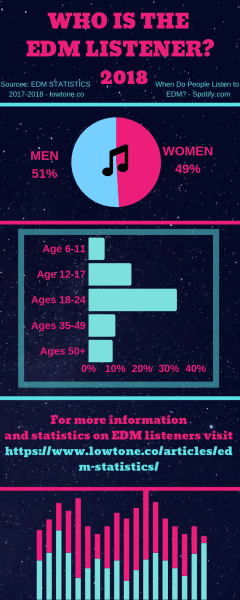
In 2014, the percentage of female’s who listened to EDM was at 45% and has increased to 49% in 2018. According to Low Tone, drum and bass artist and Phoenix DJ, music fans are generally younger, with a larger percentage (28%) having ‘some college’ education, following 18% being high school graduates.
Additional statistics on the profile of the EDM listener were gathered from Symphonic Distribution, one of the leading independent music distribution and marketing companies in the industry.
Ethnicity of EDM Listeners:
- 63% White
- 29% Hispanic
- 17% Other
- 13% African American
- 7% Asian/Pacific Islander
Household Income of EDM Listeners:
- 15% made $0-25k
- 27% made $26k-49k
- 23% made $50k-74k
- 15% made $75k-99k
- 13% made $100k-149k
- 7% made $150k+
The growth in the interest and love of EDM genre’s can be explained by the music’s rhythm, dance-ability, emotional range, unconventionality, and abstraction. Most electronic music is built around a strong rhythmic core, much more than other genre’s. Regarding the idea surrounding electronic musics unconventionality; individuals affiliation with such genres provides a sense of community and often a part of one’s cultural identity.
The driving of the electronic rhythms urge us to move our bodies and can pull complex, yet subtle emotions when people are experiencing the musical sounds.

 WELCOME TO THE LAND OF MISFIT MUSIC